
Beamer Pricing in 2026: Plans, MAU Overage, and What a Changelog Really Costs
Beamer has three paid plans in 2026 — Starter at $49, Pro at $99, and Scale at $249 a month when billed annually — pl...
Thoughts on shipping better software, writing great release notes, and building products people love. Tips for indie hackers, founders, and product teams.
Beamer has three paid plans in 2026 — Starter at $49, Pro at $99, and Scale at $249 a month when billed annually — pl...
Canny has three plans in 2026: Free for up to 25 tracked users, Pro from $79 a month billed yearly ($99 month to mont...
A hotfix is a software update released outside the normal release cycle to fix one urgent problem in software that’s ...
A release candidate (RC) is a build that will become the final release unless someone finds a serious bug in it. It’s...
softprops/action-gh-release is the GitHub Action most repositories use to turn a pushed tag into a GitHub Release — t...
GitHub can write your release notes for you. Not the customer-facing kind, but the developer-facing kind: a list of e...
semantic-release automates versioning and package publishing from commit messages. This guide configures a JavaScript...
Changesets lets contributors choose version bumps and write changelog entries in the same pull request as their code....
Release Please is Google’s answer to the release chore: it reads your conventional commits, opens a pull request that...
commitlint is the small tool that makes every other piece of changelog automation work. It checks each commit message...
Olvy’s founders announced a shutdown in late 2024, then an acquisition reversed it — and through all of it, Olvy stay...
A product changelog is the public, dated record of what you shipped, written for the people who use the product. Here...
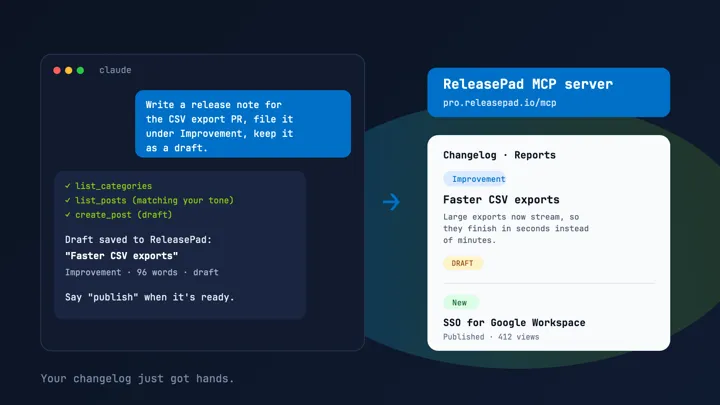
Every changelog tool has an editor. ReleasePad now has something else: a way for the AI assistant you already use to ...

Searching “changelog management tool” returns two incompatible answers: a CLI that writes CHANGELOG.md, or a SaaS pag...
Featurebase prices a whole support-and-product suite — helpdesk, Fibi AI, feedback, roadmap, help center, and a chang...

ReleasePad and LaunchNotes both end with a changelog your users can read. They start from opposite ends of the org ch...
Ten changelog tools compared on pricing, automation, and fit — dedicated changelog platforms, feedback suites with ch...
Semantic versioning in plain English: what each number promises, the 0.x escape hatch, pre-release and build tags, an...
These three artifacts get confused constantly. They serve different audiences, answer different questions, and requir...
What release management actually is, the five-stage process, how ITIL and DevOps models differ, which tools cover whi...
A product update email tells the people already using your product what changed and gives them one reason to come bac...
Five real roadmap formats with examples, which audiences each fits, and the build process — plus the companion artifa...
Copy-paste product announcement templates for each channel — changelog, in-app, email, social — real-world patterns t...
Seven changelog tools with genuinely free tiers, compared on what the free plan actually includes — caps, catches, an...
ReleasePad and Canny both end in the same place — a changelog your users read. They start from opposite ends of the p...
Five changelog templates you can copy today — the standard CHANGELOG.md, a conventional-commits variant, a SaaS chang...
Mobile release notes live inside two small boxes with hard rules — 4,000 characters on the App Store, 500 on Google P...
Keep a Changelog has been the default answer to “how should I write a CHANGELOG.md?” for over a decade. Last month it...
AI search optimization is the practice of making your content retrievable, citable and accurate in AI-generated answe...
Headway earned its place as the default lightweight changelog tool — free, simple, and easy to embed. But its own cha...
API deprecation is the act of telling the developers who use your API that a version, an endpoint, or a field is no l...
Release cadence is the rhythm at which you ship software to your users — how often a release goes out, and how regula...
Short answer: in software, it’s changelog, one word. The two-word “change log” isn’t wrong, but it’s no longer the co...
Canny is one of the best-known feedback tools in SaaS, and most people searching for an alternative fall into one of ...
AnnounceKit changed how it charges in 2026, and that’s sent a lot of teams back to compare. Here’s what its modular p...
Your changelog page looks great in a browser. Then an AI coding tool fetches it, runs it through a stripping pipeline...
llms.txt is to AI what robots.txt was to search engines: a tiny, simple file that tells machines where to look and wh...
ReleasePad and Beamer both solve the same surface problem — telling your users what changed. Underneath, they’re buil...
Your changelog is structured data behind a webpage. An MCP server flips that — exposing the same data through a proto...
An in-app changelog widget is often the single highest-leverage distribution channel for product updates. Here’s what...
Your changelog just got a new category of reader that doesn’t have eyes, doesn’t visit websites, and processes inform...
An internal changelog and an external changelog look similar but solve completely different problems. Here’s why the ...
Conventional Commits is a small rule for how to write a commit message — type(scope): description — that makes your g...
Most lists of solo founder tools stop at the moment your code is deployed. This one covers the six jobs a one-person ...
Product-led SEO is an approach to organic search where the pages that rank are produced by the product itself — its l...
“Bug fixes and performance improvements” is the most common release note there is, and it tells readers nothing. Here...
Product updates are the changes you ship to a product people already use — new features, improvements, fixes, removal...
The best changelogs don’t just list what changed — they build trust, drive adoption, and make users feel like the pro...
They’re not the same thing — and the difference matters more now that your changelog has readers who aren’t human.
Most release notes are written for developers. Your users aren’t developers. Here’s how to write updates that people ...
Most SaaS changelogs are graveyards of bullet points nobody visits. Here’s how to build one that drives adoption, red...
Stop spending hours summarizing git logs. Here are three ways to turn your commit history into a changelog — and into...
Beamer is one of the most well-known changelog tools on the market — but it’s also one of the most expensive. Here ar...
All three of the big AI coding tools will write your commit messages now, and they each do it in a different place. C...
Feature adoption is the share of your users who find a specific feature, try it, and keep using it. It’s the per-feat...
In the rapidly evolving world of large language models (LLMs), how we prepare and feed data into these systems can si...
The best way to design a changelog is to pull apart ones that already work. Here are 12 changelog examples checked in...
A changelog is an essential tool for any software or technology release, and it allows people who use your product to...
Release notes are a core part of shipping software. Every update, from a security patch to a headline feature, needs ...
Release notes are critical papers for summarizing, documenting, and communicating new software features and modificat...
For modern software companies, release notes are important as a form of communication bridging the developer company ...
Release notes are the highest-leverage document most software teams neglect. They’re how users find out the product g...
Release notes design is the visual side of telling users what changed — how an entry is built, how the page lays entr...
In today’s modern digital environment, it’s normal for software products to receive regular changes and updates. For ...